Physical Address
304 North Cardinal St.
Dorchester Center, MA 02124
Physical Address
304 North Cardinal St.
Dorchester Center, MA 02124

This article comes from the public account: Australia Daily; WeChat ID: XWWB66
//Preface//
overnight,
Air ticket prices in China and Australia are collectively “out of control”.
It was still 5,000 at noon,
In the evening, it soared to 9,000 or even tens of thousands!
Same flight, same time,
But it’s like a different world.
#01:
China-Australia flight prices skyrocketed
The Chinese community mourned
The most intuitive feeling of this round of increase in air tickets comes from ordinary consumers.
Just yesterday, many users on social platforms complained that in just one day, ticket prices between China and Australia fluctuated significantly!
Some netizens said that they were still hesitant when they saw the ticket price was more than 5,000 yuan, but after a few hours, they saw it was close to 9,000 yuan;
Some people also said that the price of a one-way ticket has increased from more than 3,000 to more than 7,000.






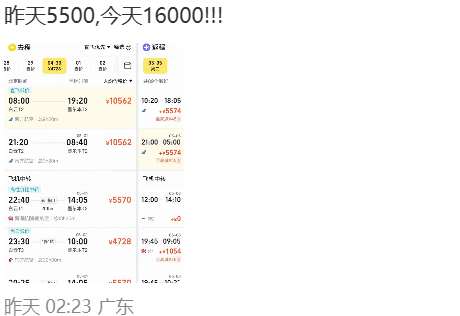
Image source: Xiaohongshu
There are even cases where the price of economy class is higher than that of business class, which makes people call it “outrageous”.

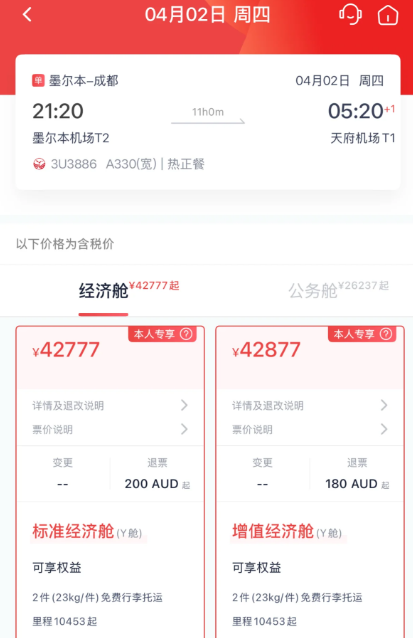
Image source: Xiaohongshu
Some passengers shared that the round-trip air ticket they bought a few days ago only cost 2,400 yuan, and now the price of the same flight has almost doubled;

Image source: Xiaohongshu
There are people here tooDuring the payment process, I encountered “ticket issuance failure”, and when I refreshed again, the ticket price had risen to tens of thousands of yuan.
Many people even lamented,“The more you read, the more expensive it becomes”, and it is even suspected to be “accurately priced” by the platform algorithm.




Image source: Xiaohongshu
Faced with rising ticket prices, many people have begun to reassess their travel plans.Some choose to postpone their return home, some switch to connecting flights, and some simply abandon the trip.




Image source: Xiaohongshu
At the same time, those who had purchased tickets in advance have become the “lucky ones” in this round of price increases, and they all said that “it’s a good thing they bought early.”
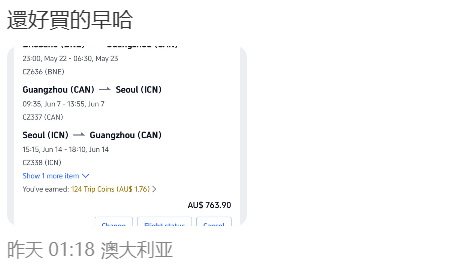


Image source: Xiaohongshu
#02:
Triple impact on demand for fuel routes,
Air ticket prices continue to rise
What users see is a “sudden surge in prices”, but behind the scenes is actually a series of chain reactions happening at the same time.
The most direct link is the soaring cost of fuel. Affected by the situation in the Middle East, global energy supply is tight and aviation fuel prices are rising rapidly.
Not only are Chinese airlines raising prices, passengers flying on Australian airlines may face a more severe situation in the future.
It is reported that China has recently asked domestic petroleum refineries to stop all fuel exports and prioritize ensuring the country’s strategic energy needs.
According to the Australian Financial Review, at least two batches of fuel cargo originally scheduled to be shipped to Australia are currently in uncertainty, and there are still variables whether they can be delivered smoothly. For a country like Australia that is highly dependent on imports, the difficulty of obtaining external fuel is rising rapidly.
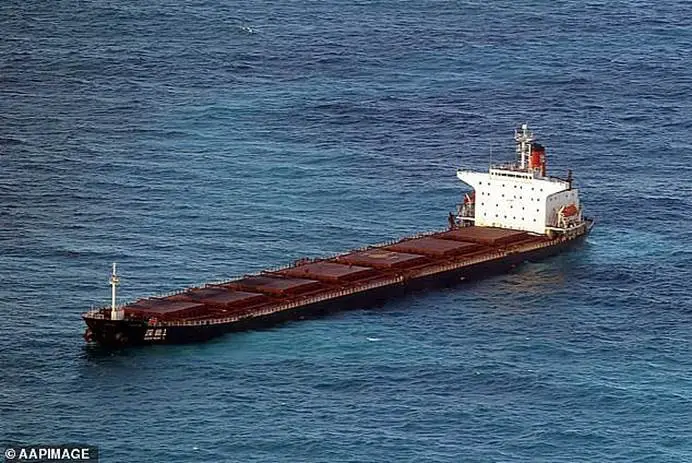
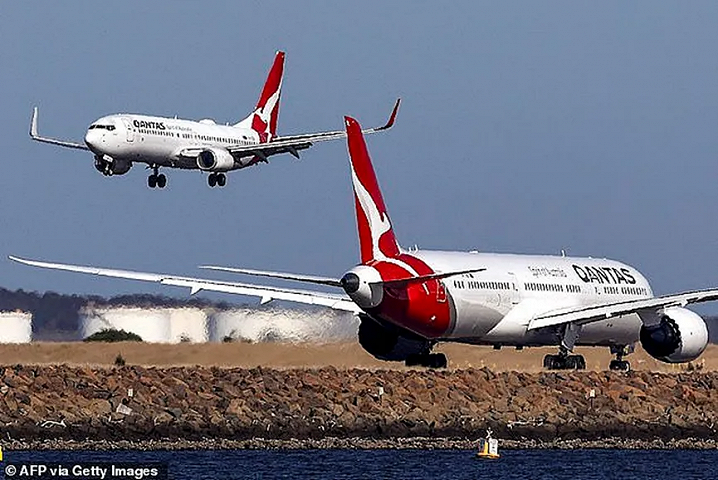
Image source: Daily Mail
The crux of the matter is that Australia has almost no buffer space in aviation fuel.As a net importer of liquid fuels, about 90% of Australia’s oil comes from the Middle East. At the same time, it is highly dependent on the Asian refining system for processing and supply. The country has almost no refining capacity for aviation kerosene.
Sydney Airport CEO Scott Charlton also made it clear that the aviation fuel used by the airport is completely dependent on imports and lacks any substantial local refining capacity to support it.
China occupies a key position in this supply system.
Data shows that about 32% of Australia’s aviation kerosene will come from China in 2025, which is significantly higher than other Asian countries. Once China tightens or even stops exports, it will be difficult for Australia to find a completely alternative and stable source in a short period of time.
For airlines, fuel is their “life”. When costs rise, there is almost no room for price increases.
Many airlines, including Qantas, have already “said hello” in advance: fares are going to rise. This is not a choice, but is driven by costs.
Related reading:Unexpected! International flight fares have been raised across the board! Many flights back to Australia have been canceled urgently
Related reading:Breaking news! Australian flights may be canceled on a large scale, and ticket prices are about to soar.
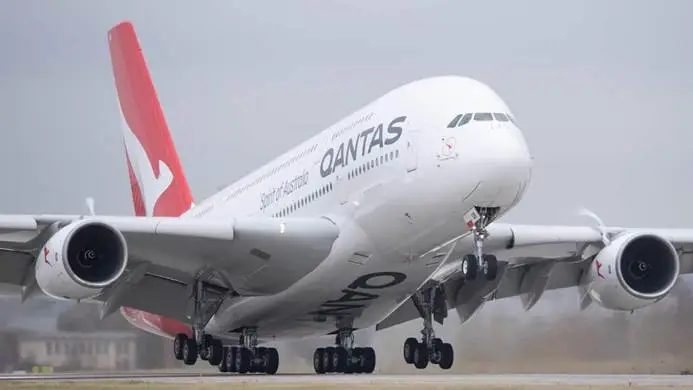
Image source: SBS
A more hidden reason is that “the route has been rewritten.”
Originally, many international flights relied on transit in the Middle East. Now that some airspace is restricted, flights have to detour to other regions in Asia, flying further, burning more fuel and taking more time.It’s like traveling on a highway but now being forced to take a detour through the mountains. Not only is it slower, it’s also more expensive.
Once the detour is combined with tight capacity, the result will be fewer seats and higher prices.
At the same time, students studying abroad, visiting relatives, and traveling during holidays are all in urgent demand. Once everyone books tickets at the same time, low-price seats will be quickly “emptied out.”
The price of air tickets does not increase linearly, but in a “step-by-step” manner. Once the cheap tickets are sold out, the price of the next ticket may be several thousand yuan more expensive, so there is a sense of disconnection of “5,000 yesterday, 9,000 today.”
Finally, one of the most “irritating” factors is dynamic pricing.
Many people complain that “the more you look at it, the more expensive it becomes.” This is actually not an illusion.
When a large number of users repeatedly search for the same flight, the system determines that demand is increasing and automatically raises prices. You think you are just taking a look, but in the eyes of the system, this is a “strong buying signal.”
As a result, a subtle cycle is formed: the more anxious people are and the more frequently they inquire, the faster the price rises.
When fuel is rising, routes are changing, seats are reducing, demand is concentrating, and the system is accelerating, when these forces are added together, air ticket prices no longer change slowly, but jump quickly as if “ignited.”
#03:
Will remain high in the short term,
Fares may become more expensive as time goes by
The sudden rise in ticket prices on China-Australia routes is the result of global energy prices, route adjustments and changes in supply and demand structure.
In the short term, as long as fuel costs remain high and flight capacity is not fully restored, air ticket prices are likely to remain within a relatively high range.
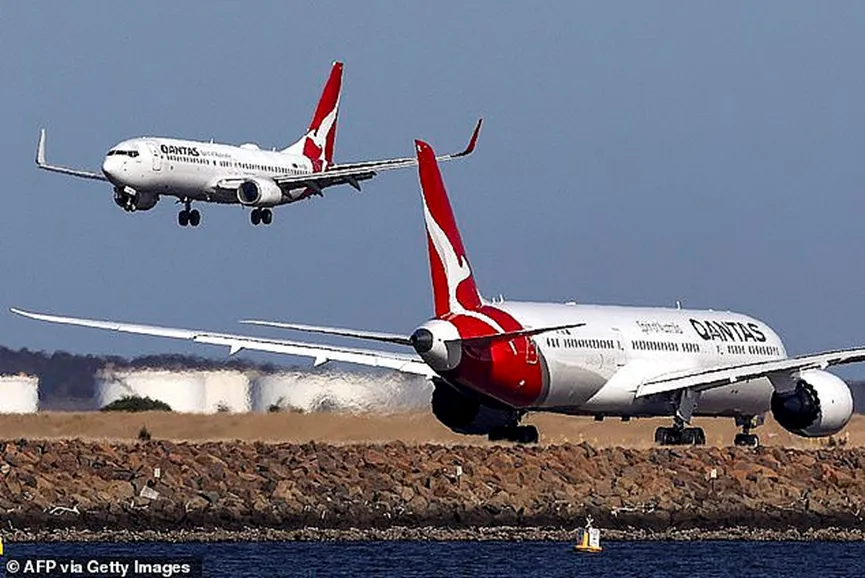
Image source: Daily Mail
For people who have already decided on their itinerary, especially international students, visiting relatives or passengers who must travel, the earlier they book their tickets, the more controllable prices and seats they can lock in. Unlike many people who expect “imminent promotions”, there is almost no logic of “the later the flight is, the cheaper it is” in peak season air tickets. On the contrary, the longer the delay, the more expensive it becomes.
If you have a limited budget, you need to make strategic adjustments.Traveling at staggered peak times, flexible dates, changing transit locations, and even choosing a combination of different airlines are all realistic and feasible ways.
Also, be sure to pay attention to the cancellation and exchange policy.Low-price tickets often have strict restrictions. Once the itinerary is uncertain, it is safer to choose a more flexible ticket type.
It is worth noting that this round of price increases does not only affect international flights. Local route prices are also rising quietly, and the logic behind it is consistent: fuel costs are being transmitted to the entire economic system.
at last
Rising oil prices and increased transportation costs,
It will ultimately be reflected in the price of the product.
From air tickets to logistics to daily consumption,
This is a systemic cost increase.
Related reading: