Physical Address
304 North Cardinal St.
Dorchester Center, MA 02124
Physical Address
304 North Cardinal St.
Dorchester Center, MA 02124

This article is reproduced from the WeChat public account: Aozhiwang
Xiaohongshu hit the screen overnight
A large number of Chinese Australians have been laid off!
Some people are starting to consider turning to blue-collar work
Someone starts reducing their debt!
8.5 million white-collar workers are at risk…
A crazy “bloodbath” of Australian white-collar workers
It has arrived quietly…
In the past few days, a topic suddenly hit the screen on Xiaohongshu – layoffs!
Many Chinese working in Australia are sharing their experiences. Some have just been laid off, some are being laid off by their companies, and some are worried about whether it will be their turn next.
Originally there were only sporadic discussions, but as more and more posts appeared, the entire Chinese community soon began to become anxious!
Many people have mentioned an obvious change: the Australian job market has suddenly become extremely crowded!
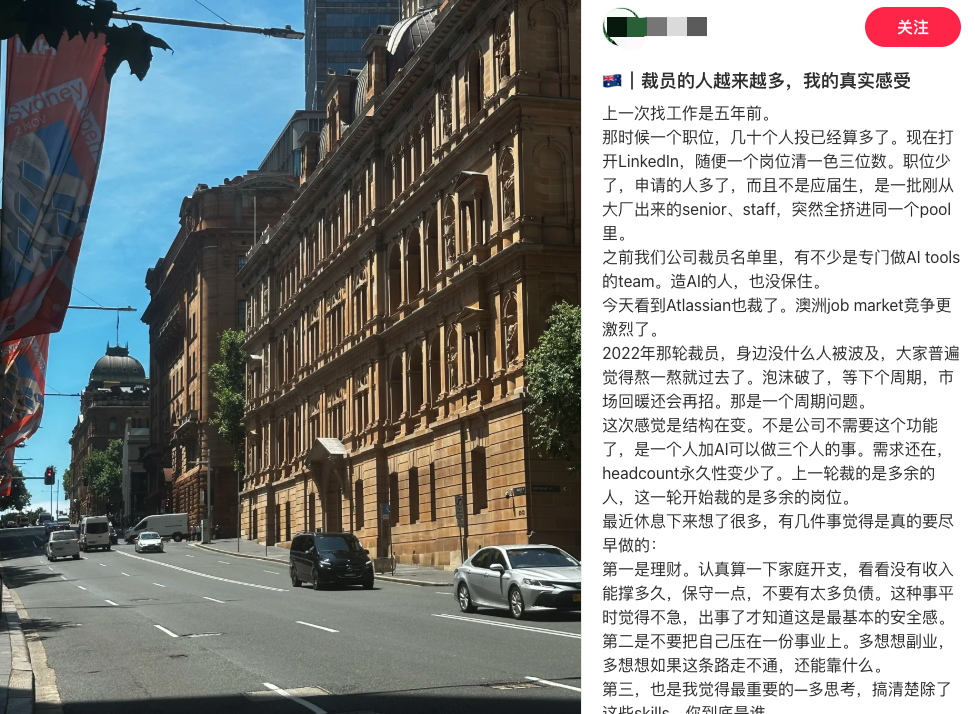
A netizen working in Australia posted: “More and more people are being laid off. This is my true feeling. The last time I looked for a job was five years ago. At that time, dozens of people applied for one position, which was considered too much.”
But it’s completely different now!
He said: “When I open LinkedIn now, every position has three digits. There are fewer positions, more people are applying, and they are not fresh graduates.”

What’s even more stressful is that now the background of the competitors has completely changed.
In the past, many positions were mainly competed by ordinary job seekers or graduates, but now a large number of employees from large companies have suddenly flooded into the market.
Many people feel very real when they see this. Because many Chinese working in Australia have clearly felt that – jobs are decreasing, but competitors are increasing!
And this wave of discussion actually has a background.
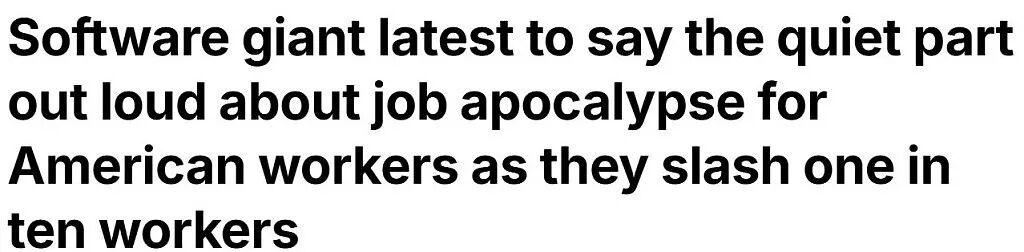
Just recently, Australian tech giant Atlassian Announce layoffs1,600 peopleaccounting for approximately 10% of the total number of employees10%. This company has a very high status in the Australian technology industry. Its products Jira and Confluence have more than 300,000 customers, including many Fortune 500 companies.
Therefore, when such a company suddenly announces large-scale layoffs, the entire industry is almost shocked!
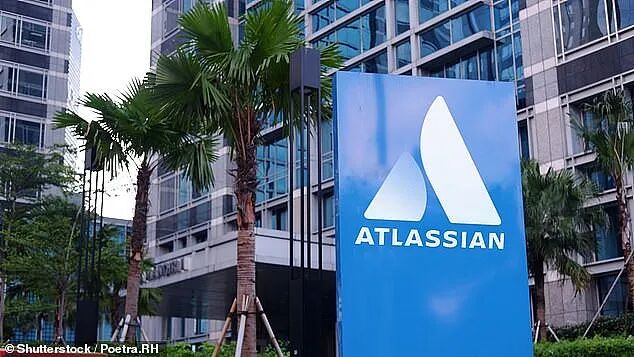
Many Chinese circles exploded instantly.
Someone directly lamented: “Australia’s No. 1 factory was bloodbathed today!”
Someone else posted: “Atlassian laid off 1,600 people today. OMG, is IT really a twilight industry?”

According to information released by the company, the reason for this layoff is that the company is investing more resources in artificial intelligence and enterprise sales.
In other words, AI is changing the company’s employment structure.
A more realistic scene is: after the news was announced, the company’s stock price actually rose!

Seeing this, many people actually have mixed feelings. On the one hand, companies are talking about the future and technological upgrades, but on the other hand, it means that a large number of employees have left their jobs.
In the Xiaohongshu comment area, many people also began to seriously discuss a question: What kind of job should I do in the future?
Some people suggest that you simply switch to blue-collar jobs, such as electricians, carpenters and other skilled trades. Some netizens directly left a message: “Get an electrician!”
Someone else said: “Now that we are in Australia, I will definitely join the Tradie circuit!”

But soon, someone came out to remind everyone not to be too idealistic.
A netizen who has switched from white-collar work to construction site work shared his experience:
“You have to be in awe of a profession. Blue-collar work requires a lot of physical effort, which is different from mental effort. I just changed careers and worked at the construction site for a month. It was really difficult. I had joint pain and muscle pain every day. The key is that my annual income was not high when I first started.”

He said that although he felt a sense of accomplishment when he completed the work, the process was really much harder than he imagined.
Some netizens raised another concern:
“Don’t follow the trend of blue-collar workers. The prerequisite for high blue-collar wages is that there are a large number of high-paying white-collar workers who pay to hire blue-collar workers. If AI really replaces white-collar workers and everyone becomes blue-collar workers, then we will step by step return to the state of twenty years ago.”

At the end of the post, the netizen who posted also wrote some reflections of his own. He said that he had been thinking about a lot of things during his recent break, and several of them must be considered early.
“Calculate your household expenses and see how long your income will last. Be conservative and don’t have too much debt.”
This sentence seems very simple, but many people are silent after reading it.

Because more and more people are beginning to realize that white-collar professions that were once considered stable, well-paying, and decent are now beginning to experience uncertainty!
The Australian workplace seems to be changing quietly…
02 8.5 million jobs may be impacted by AI! Is the “Great Purge” of white-collar workers really coming? Chinese people are more stressed in the workplace…
If Atlassian’s layoffs are just a signal, then a subsequent study makes many people even more uneasy.
Clinton Free, a professor at the University of Sydney Business School, recently issued a very stern warning!
If AI develops as expected, more than 8.5 million jobs in Australia may be affected.
This number is equivalent to almost half of Australia’s workforce.
Professor Free conducted an in-depth analysis of Australia’s occupational structure based on a study released by the AI company Anthropic. The results show that AI is changing the job market at an unprecedented rate.
He said that if the technological potential of AI is truly transformed into reality, it will be a “social change beyond imagination.”
What is even more surprising is that the biggest impact this time is not on traditional blue-collar workers, but on white-collar workers.
The study found that industries with the highest automation potential include: computer programming, financial industry, administrative offices, management positions, and legal industry.
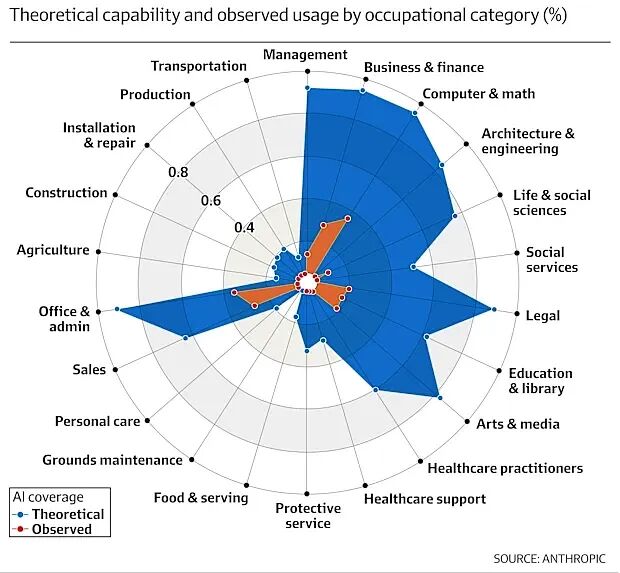
In other words, those occupations that were once considered the most stable and respectable have now become the riskiest groups.
Moreover, those who are hit this time are often people with high education and high income.
Data show that employees with a bachelor’s degree are three times more likely to face a career change than those with a graduate degree, and graduate students are even four times more likely to change.
The reason is actually very simple.
What AI is best at processing is text, data, and analysis, which are the core content of white-collar jobs.
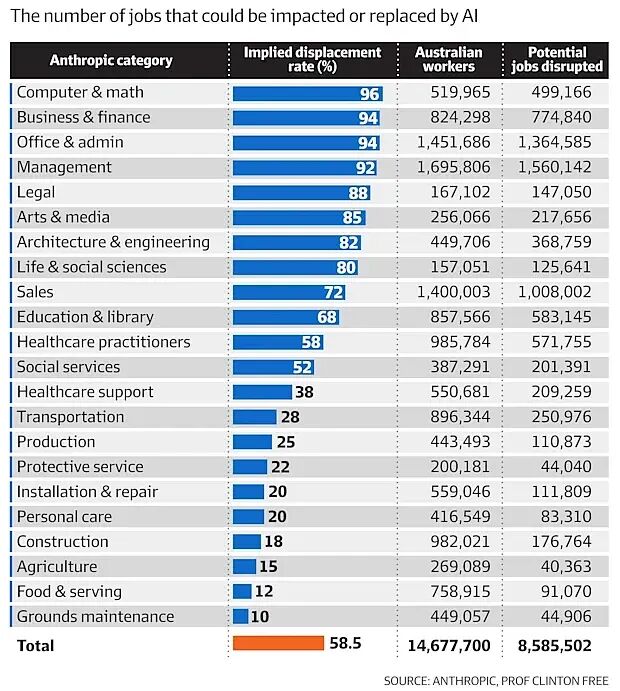
Professor Free even pointed out that this is the first time in history that cognitive tasks are more likely to be replaced by automation than manual tasks.
But if you look at it from a Chinese perspective, this problem may be more realistic.
Many Chinese working in Australia actually know that in the local workplace, it is often difficult for Chinese to enter the real core management.
The so-called “glass ceiling” has always existed.
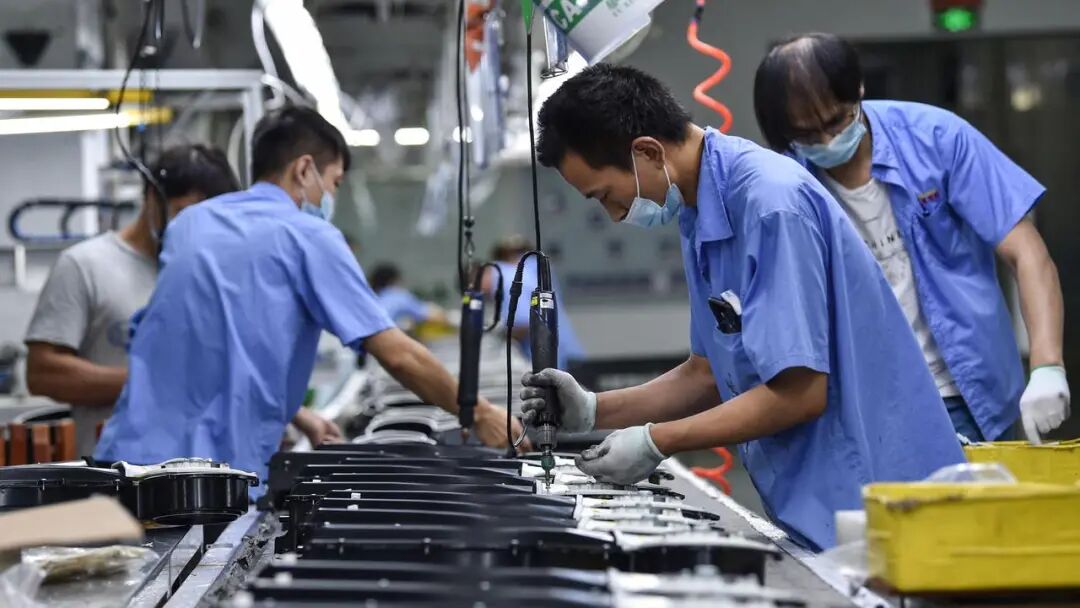
There are many Chinese in technical positions, financial positions, and engineering positions, but the proportion of people entering senior management is not high.
In other words, many Chinese are actually concentrated in middle-level and executive-level positions. When companies lay off employees, these positions are often the first to be affected.
Therefore, when a wave of layoffs occurs, the Chinese will feel more pressure.
Some experts have even begun discussing an extreme possibility:
If AI really replaces jobs on a large scale, the government may need to study a system like “universal basic income” in the future.
Of course, some people think things will not be so pessimistic.
Jeff Borland, a professor at the University of Melbourne, believes that AI is more of a tool to improve productivity.
It will indeed eliminate some jobs, but it will also create new ones.
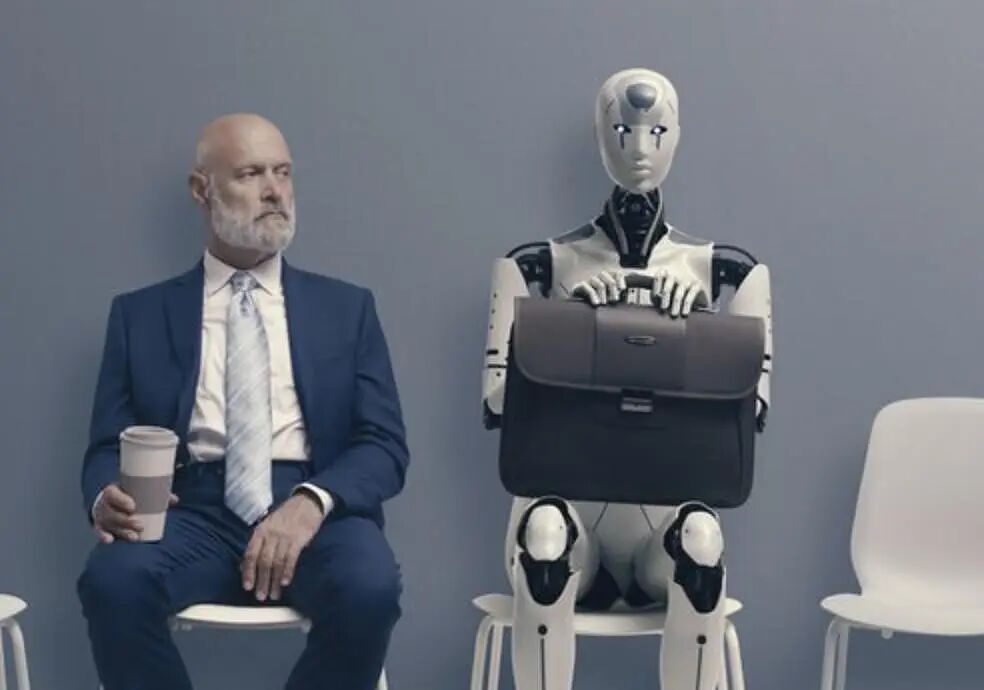
But Professor Free still warned not to be too optimistic.
He said that many industrial transformations in history have not been so smooth.
He cited the decline of manufacturing in the United States as an example. After a large number of factories closed that year, many unemployed workers did not find new jobs, but directly exited the labor market.
What is left behind are social problems that have lasted for decades.
This wave of layoffs is actually not just a problem for individual companies, but the entire era is changing. AI is reshaping the industry structure, and white-collar jobs that were once considered the most stable are now beginning to experience turmoil.
For many Chinese working hard in Australia, they have to face multiple pressures such as language, culture and workplace ceiling. Once the economic environment turns cold, layoffs are often more likely to be the first group of people affected. Times are changing, and so are the rules of the workplace. Perhaps the only thing you can do is to stay vigilant, constantly improve your abilities, and at the same time leave a little more safety buffer in your life. No one can be sure of what the future will bring, but the sooner you realize the changes, the easier it may be to deal with them.
Related reading: