Physical Address
304 North Cardinal St.
Dorchester Center, MA 02124
Physical Address
304 North Cardinal St.
Dorchester Center, MA 02124

New Zealand Chinese Herald website comprehensive report on home security The latest international migration data released today by Statistics New Zealand (Stats NZ) shows that New Zealand’s net migration was about 23,200 people in the year to January 2026, an increase from the previous year. However, compared with the historical high reached in 2023, the current immigration growth has slowed down significantly.
Annual net immigration is approximately 23,200 people
The data shows that in the year to January 2026:
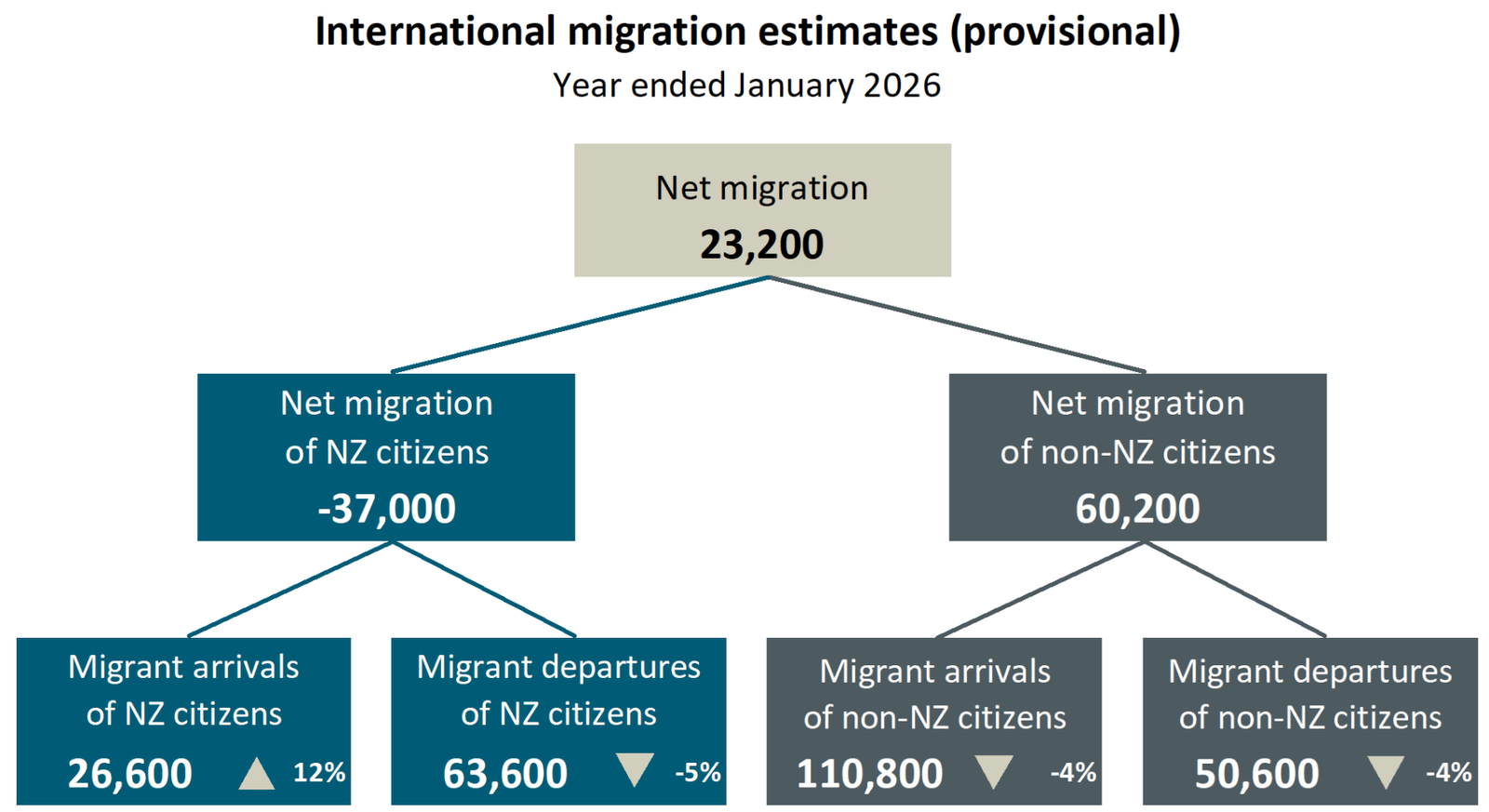
Annual net migration increased by about 23,200, compared with 19,700 in the year to January 2025.
The Bureau of Statistics pointed out that the annual number of immigrant arrivals peaked in October 2023, when it was approximately 234,800 people; and the annual net immigration number also reached a record high during the same period, with a net increase of 135,500 people.
In the long-term average before the epidemic (2002 to 2019), about 118,700 people entered and 91,700 left each year, with a net migration of about 27,000 people.
The statistics office said immigrants are people who change their country of residence, regardless of their nationality or visa type. Statistics usually use 12 months of residence as the criterion.
Non-New Zealand citizens drive net migration growth
Net migration increased by 23,200 in the year to January 2026, driven mainly by non-New Zealand citizens.
in:
This compares with a net loss of 43,600 New Zealand citizens in the year to January 2025.
Looking at the long-term trend, from 2002 to 2013, the average annual net loss of New Zealand citizens was about 27,100 people; between 2014 and 2019, the number dropped to an average of 7,500 people.
China, India and the Philippines are the main sources of immigrants
The nationalities with the largest numbers of arrivals in the year to January 2026 include:
The nationalities with the largest number of departing immigrants include:
The Bureau of Statistics pointed out that immigrants from India, China, the Philippines and Sri Lanka are the main sources driving net migration growth in 2026.
It should be noted that the “nationality” in the statistics refers to the country where the passenger uses the passport, and does not necessarily represent the country where the passenger has previously lived or will live in the future.
Net migration increased significantly in a single month
In the month of January 2026, the inflow of immigrants to New Zealand increased significantly:
Net immigration increased by about 4,800 people in a single month, while in January 2025, net immigration increased by only about 100 people that month.
The Bureau of Statistics said that immigration data are preliminary estimates and may still be revised for approximately 16 months after release.
New Zealand continues to experience net population outflow from Australia
Population flows with Australia still show a net outflow trend.
New Zealand’s net migration loss to Australia in the year to June 2025 is about 29,100, including:
Among them, the net loss of New Zealand citizens was approximately 28,400.
Data shows that about 62% of its citizens leaving New Zealand went to Australia.
In addition, about 35% of New Zealand citizens who immigrate to Australia were actually born outside New Zealand.
Historically, there has been a long-term trend of population migration from New Zealand to Australia. From 2004 to 2013, the average annual net loss was about 30,000 people; from 2014 to 2019, it dropped to about 3,000 people per year.
Related reading: