Physical Address
304 North Cardinal St.
Dorchester Center, MA 02124
Physical Address
304 North Cardinal St.
Dorchester Center, MA 02124

This article comes from the public account: Australia Daily; WeChat ID: XWWB66
//Preface//
The conflict in the Middle East triggered sharp fluctuations in oil prices.
Global inflation risks are heating up again.
Several major banks are suddenly betting:
The Reserve Bank of Australia may raise interest rates again next week.
#01:
Conflict in the Middle East pushes up oil prices,
Expectations for interest rate hikes in Australia are rising rapidly
The situation in the Middle East continues to be tense, global oil prices fluctuate violently, and this conflict thousands of miles away is rapidly affecting Australia’s economic prospects.
With oil prices once approaching $120 a barrel, market concerns about a resurgence of inflation have continued to intensify. A growing number of traders and economists believe thatThe Reserve Bank of Australia (RBA) may raise interest rates again at next week’s interest rate meeting to prevent inflation from getting out of control again.

Image source: Australia Financial Review
As Iran-related conflicts continue to escalate, global energy markets have experienced violent fluctuations. Oil prices had previously soared to nearly $120 a barrel on concerns that energy transportation in the Strait of Hormuz could be disrupted in the long term.
The strait is responsible for about 20% of the world’s energy transportation. Once problems occur, global energy supply will be greatly impacted.
Although the price of Brent crude oil subsequently fell back and is currently around US$87 per barrel, this sharp rise has triggered concerns about a resurgence of global inflation.
In this context,More and more financial institutions are beginning to predict that the Reserve Bank of Australia will raise interest rates ahead of schedule.
The economic teams of a number of large banks, including Westpac, National Australia Bank (NAB) and Commonwealth Bank (CBA), now generally expect the RBA to raise the official cash rate by 25 basis points next week.
Image source: The Australian
If this prediction comes true, it will be the second consecutive interest rate increase after the Reserve Bank of Australia raised the base interest rate once in February this year.
According to predictions by some institutions, if inflation remains stubborn, interest rates may even continue to rise in the coming months.
Judging from market expectations, the probability of interest rate hikes is also rising rapidly. The money market pricing model shows thatThe market currently believes that the probability of raising interest rates at the March meeting has reached about 70% to 80%significantly higher than the previous level of less than 40%.
#02:
The central bank’s hawkish signal is released:
Inflation remains the biggest threat
The rapid changes in market expectations are largely due to the hawkish signals recently released by RBA executives.
Reserve Bank of Australia deputy governor Andrew Hauser said in a podcast interview that if the central bank does not act decisively to control inflation,
“It’s going to be bad for everybody.”
This statement was regarded by the market as an obvious policy signal. Subsequently, the Australian dollar exchange rate rose rapidly, once rising to 0.7185 US dollars, the highest level since mid-2022. At the same time, Australian government bond yields also increased significantly.
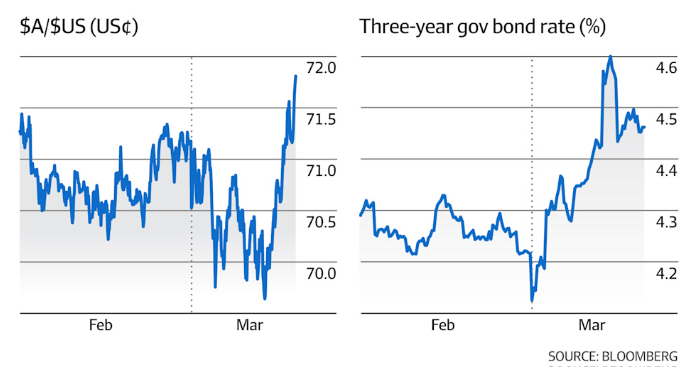
Image source: Australia Financial Review
Hauser also warned that Australia never wants to experience an inflation crisis similar to 2022 again. At that time, the conflict between Russia and Ukraine caused energy prices to soar, causing Australia’s inflation rate to reach 8%.
Currently, Australia’s overall inflation rate remains at 3.8%, significantly higher than the central bank’s target level of 2.5%.

Image source: Australia Financial Review
Hauser predicts that by June this year, inflation may exceed the central bank’s previous forecast of 4.2%.
At the same time, Australia’s economic fundamentals remain strong.
Data show that economic growth reached 2.6% in the fourth quarter of 2025, which is higher than trend growth. The job market remains tight, and wages and consumer demand remain resilient. These factors mean that inflationary pressures may continue to exist.
Many international investment banks also quickly adjusted their expectations.
Institutions such as Bank of America, UBS, Citigroup, Deutsche Bank and Capital Economics all believe that the possibility of the central bank raising interest rates in the near future has increased significantly.
Analysts pointed out that the rise in oil prices caused by the Iran conflict may become a new “inflation shock”, which also provides practical reasons for the central bank to adopt more aggressive policies.
at last
If oil prices remain high,
Inflation expectations have further increased,
Next week’s interest rate decision is likely to be a new turning point.
For ordinary families,
This also means that mortgage pressure may rise again.
The Australian economy will also usher in
A new round of tests for monetary policy.
Ref:
Related reading: