Physical Address
304 North Cardinal St.
Dorchester Center, MA 02124
Physical Address
304 North Cardinal St.
Dorchester Center, MA 02124

Chinese Herald columnist Skee
– Stop waiting for motivation. What really changes people is habits.
“I just can’t get excited.” This is perhaps one of the most common sentences we hear in our working lives.
Many people think that things will not start until they have motivation, status, and energy.
So they have been waiting – waiting for inspiration, waiting for impulse, waiting for “one day when I have time” or “not so tired”. The result is often: a lot of thinking and planning, but never really starting.
I would like to say something reassuring first: This is not because you are not self-disciplined enough, nor does it necessarily mean that you are not motivated enough. But many of us have misunderstood where “motivation” comes from.
Motivation is not the starting point, but the result
In my psychology practice, I have seen two types of people:
One type is those who are experiencing depression and low mood, and motivation itself is a symptom.
The other type is those whose life functions are normal, but always feel that there is “a little impetus”
They want to: exercise more, study more, start a side job, develop a hobby. But things always stay at “thinking” and are then replaced by procrastination.
I myself have been in this state for a long time. It wasn’t until later that I discovered one thing:
The reason why I am not very“Waiting for power”because I no longer regard motivation as a prerequisite.
Treat important things like brushing your teeth
When I decide to do something, I usually only ask myself two questions:
Is this thing of value to me?
With my current time and energy, can I afford it?
If the answer is “yes”, then I won’t ask again: “Do I want to do it?” but go directly to the next step: turning it into a habit.
We brush our teeth, never looking at our mood. No matter whether we are busy that day, tired or not, inspired or not, we brush our teeth.
I started trying to treat work, writing, and sports the same way. Do fixed things at a fixed time, even if your status is average.
If energy is low, I lower the standards but don’t cancel the behavior:
In terms of psychological principles, I call this“Sit on the butt first principle”. Many things will only continue after you sit down.
People who are waiting for motivation often have the hardest time persisting
I often advise my friends and remind myself: Don’t wait for motivation, build a habit first.
Those who are willing to try this are generally more likely to persevere and feel less guilty than those who wait until “it feels right.”
Interestingly, when the habit becomes stable, the motivation will increase and the enthusiasm will become higher and higher. But that is already the result, not the starting point.
So, how to build a habit?
I usually share a few very simple, yet practical principles.
1. Check first: do you really want this habit? (Get Real)
Every new habit has an “opportunity cost.”
Every extra hour you work may mean you miss an hour to rest, exercise, or spend time with your family.
In this era full of “you should work harder”,
Sometimes, the wisest decision is to admit that you don’t want to, and it’s not appropriate, to add one more thing right now. Not all goals are worth achieving at this stage.
2. Start small, simple and regular, more important than ambition (Start Small)
Many New Year’s resolutions fail not because they don’t try hard enough, but because they are too big in the first place.
Actions that are small enough not to fail are more important than perfect plans. Moreover, it’s enough to develop one new habit at a time.
3. Connect new habits to old habits (Habit Stacking)
One of the easiest ways to create new habits is through “habit stacking.” For example:
When walking your dog, switch from walking to jogging
When you turn on your phone, use the screen time to read a magazine article
While driving to and from get off work, listen to music, exclusive interviews, or lectures by experts.
While you wait for your coffee to brew, use Duolingo to learn for 5 minutes
After breakfast, meditate for 3 minutes
You are not squeezing 🎧 more time, you are just using 🎧 a new action that already exists.
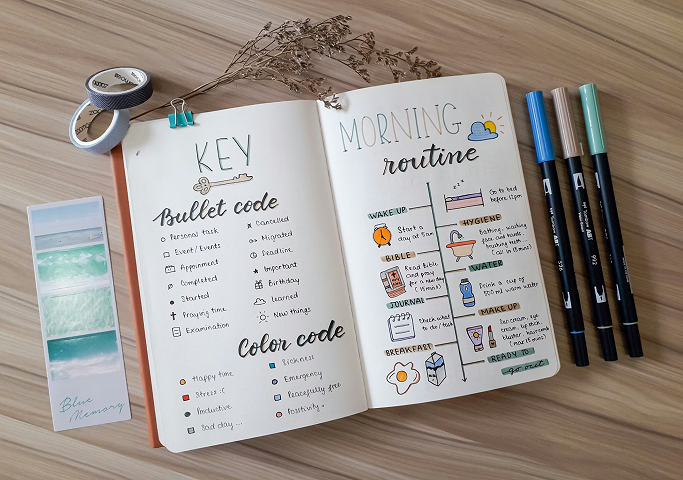
4. Review regularly, rather than just rely on it (Evaluate)
There is something very important but often overlooked: habits can be adjusted or even abandoned. You can ask yourself once a month:
Is this habit still helping me?
Does it bring growth or pressure?
When a habit no longer suits you now, allowing yourself to adjust is maturity, not failure.
Conclusion
When you start to use habits instead of emotions to support your life, you will slowly discover:
Self-efficacy is improving
Life becomes more in control
And “motivation” often only appears after you have walked a certain distance.
In the new year, instead of asking yourself “Am I motivated?”, it’s better to ask a gentler and more effective question:
“Can I do a little bit today?”
Related reading: